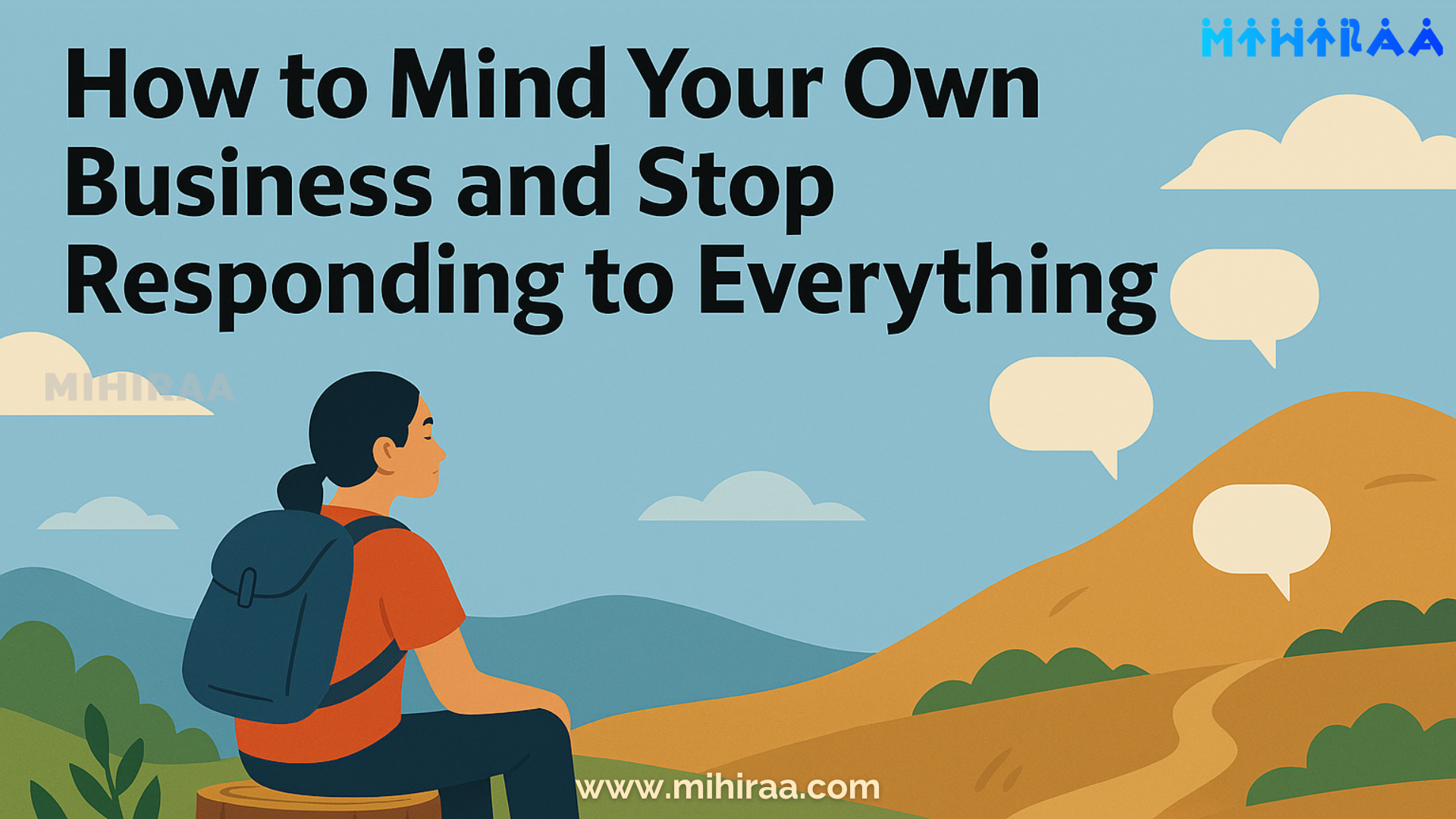
How to Mind Your Own Business and Stop Responding to Everything
A Practical Guide to Reduce Stress at Work, in Public, Online, and in School
Why Minding Your Own Business Is a Life Skill in a Noisy World
In today’s opinion-heavy, hyper-connected world, one of the biggest challenges is knowing when not to respond. From workplace gossip and office politics to social media arguments and public provocations, reacting to everything leads to stress, burnout, anxiety, and loss of focus.
Learning how to mind your own business is not about being cold or careless. It is about protecting your mental peace, conserving emotional energy, and focusing on your own goals. This guide solves a real-life problem faced by professionals, students, and the general public: how to stop unnecessary reactions and live with calm, clarity, and control.
1. What Does “Mind Your Own Business” Really Mean?
Minding your own business means:
- Staying within your circle of control
- Avoiding emotional investment in gossip, opinions, and conflicts that do not affect you
- Choosing peace over being right
- Practicing selective engagement instead of reacting automatically
This is intentional boundary setting, not avoidance or weakness.
2. Why Do We Overreact? The Psychology Behind Emotional Reactions
Most people react unnecessarily because of:
- Ego and the need to prove themselves
- Fear of judgment or disrespect
- Habitual emotional responses
- Desire for validation
The brain treats criticism or provocation as a threat. Reacting gives short-term relief but long-term regret. Understanding this psychology helps you regain control over your responses.
3. How to Stop Reacting to Everything (The Pause Method)
Before responding to any situation:
- Pause and breathe
- Ask: Is this my responsibility?
- Ask: Will this matter in a week?
- Decide: respond intentionally or stay silent
This simple pause breaks emotional habits and prevents unnecessary conflict.
4. Silence Is Power: Why Not Responding Works
Silence is not weakness. “Silence is emotional intelligence.”
When you stop reacting:
- Conflicts lose momentum
- Manipulative people lose interest
- Your confidence becomes visible
- Your professional and personal reputation improves
Many arguments end because one person refuses to engage.
5. How to Mind Your Own Business at Work
Workplaces are filled with gossip, unsolicited opinions, and hidden power struggles. Reacting emotionally can damage credibility and careers.
Practical workplace strategies:
- Use neutral replies: “I see,” “Noted,” “Understood”
- Avoid gossip and complaint cycles
- Redirect to work: “I need to focus on this task”
- Mute non-essential group chats and emails
- Exit conversations politely without explanation
Professionals who master silence are seen as focused, reliable, and leadership-ready.
6. How to Mind Your Own Business in School or College
In schools and colleges, reacting impulsively can affect grades, mental health, and discipline records.
Smart student habits:
- Treat education as your main mission
- Avoid campus gossip and online arguments
- Use headphones as a boundary signal
- Keep group work discussions task-based
- Respond only to academic or official matters
Silence protects your future more than arguments ever will.
7. How to Ignore People and Stay Safe in Public
Public confrontations often escalate quickly.
Public peace strategies:
- Avoid eye contact with provokers
- Walk away without explaining yourself
- Use headphones as a “do not disturb” sign
- Remind yourself: My peace is worth more than this
Silence in public is often a safety skill, not avoidance.
8. How to Stop Reacting on Social Media and Online
Social media thrives on emotional reactions.
Digital discipline tips:
- Unfollow or mute triggering content
- Avoid comment wars
- Use the 24-hour rule before responding
- Schedule social media usage
- Practice digital silence
Not every post deserves your attention or energy.
9. How to Practice Non-Reactivity Every Day
Non-reactivity improves with practice:
- Let one unnecessary comment pass daily
- Reflect: Did reacting improve anything?
- Detach self-worth from others’ opinions
- Focus energy on growth and goals
With consistency, silence becomes a strength.
10. Common Myths About Not Responding
Myth: Silence is weakness
Truth: Silence shows confidence
Myth: You must defend yourself
Truth: Actions speak louder than explanations
Myth: Ignoring people is rude
Truth: Unnecessary engagement causes more damage
Conclusion: Choose Peace Over Proving a Point
Learning how to mind your own business and stop responding to everything gives you freedom—from stress, drama, regret, and emotional exhaustion.
“Not every situation deserves your voice.“
“Not every opinion needs your response.“
Sometimes, the most powerful answer is no answer at all.
Protect your peace. Focus on your life. That is a real strength.