IELTS Writing Task 1: Sample Answer
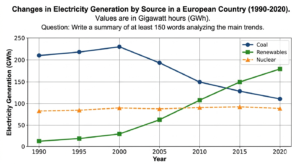
The line graph illustrates the changes in electricity production from three different sources—coal, renewables, and nuclear power—in a specific European country between 1990 and 2020. Values are measured in gigawatt-hours (GWh).
Overall, the period witnessed a dramatic shift in the country’s energy mix. While coal was initially the dominant source of electricity, its use experienced a sharp decline over the 30-year period. Conversely, renewable energy grew exponentially to become the primary source of power by 2020. Meanwhile, nuclear energy generation remained consistently stable throughout.
In 1990, coal was by far the leading source of electricity, generating just over 200 GWh. This figure peaked slightly at approximately 230 GWh in 2000 before embarking on a steady downward trajectory, ultimately dropping to its lowest point of roughly 110 GWh in 2020. In stark contrast, renewable energy started as the least utilized source in 1990, accounting for a mere 12 GWh. However, it experienced rapid, uninterrupted growth after 2000, overtaking nuclear power around 2008 and coal by 2013, before culminating in a peak of 180 GWh at the end of the period.
Throughout this 30-year timeframe, nuclear power exhibited the least fluctuation. It began at around 80 GWh in 1990, experienced a negligible rise to just under 90 GWh by 2000, and maintained a flat, steady plateau near this level for the remaining two decades, closing at approximately 88 GWh in 2020.
Key Vocabulary & Features Used:
-
Structure: 4 distinct paragraphs (Introduction, Overview, Body Paragraph 1 focusing on major trends/intersections, and Body Paragraph 2 focusing on stable data).
-
Trend Vocabulary: Downward trajectory, grew exponentially, sharp decline, uninterrupted growth, steady plateau.
-
Data Approximations: Just over, approximately, a mere, roughly, just under. (Essential since the exact numbers are not written on the data points).
-
Word Count: ~240 words (perfectly meets the “at least 150 words” requirement while remaining concise and accurate).