
Lunar Eclipse 2025: Blood Moon Viewing Guide for September 7
Lunar Eclipse on September 7, 2025—a total lunar eclipse nicknamed the “Blood Moon”—will be visible for up to 82 minutes in some regions. Wondering, “Is the lunar eclipse visible in my area?” This guide answers that and more. We provide exact viewing times and global visibility zones, explain how to watch a total lunar eclipse, and detail the science behind the blood moon and ‘Chandra Grahan’. Learn how to safely enjoy this celestial event, whether you’re into astronomy, stargazing, or casual skywatching.
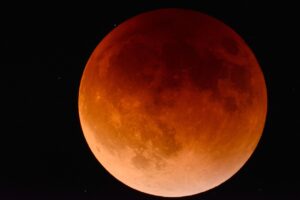
- What is the September 2025 Lunar Eclipse?
A lunar eclipse occurs when the Earth moves directly between the Sun and the Moon, casting its shadow onto the lunar surface. The event on September 7, 2025, will see the Moon pass through the darkest part of Earth’s shadow, known as the umbra, resulting in a total lunar eclipse. As the Moon becomes fully immersed, it will take on a striking reddish-orange hue, earning it the nickname “Blood Moon.” Unlike a solar eclipse, a lunar eclipse is completely safe to view with the naked eye and requires no special protective equipment.
- Significance of the ‘Blood Moon’
The September 2025 lunar eclipse holds both scientific and cultural importance. Scientifically, the red colour of the ‘Blood Moon’ is caused by Rayleigh scattering—the same phenomenon that creates red sunrises and sunsets. As sunlight passes through Earth’s atmosphere, shorter wavelengths of blue light are scattered away, while longer red wavelengths are bent (refracted) into the umbra, illuminating the Moon in a deep copper or crimson glow. This event allows scientists to study the state of Earth’s upper atmosphere by analysing the eclipse’s darkness and colour. Culturally, lunar eclipses, or ‘Chandra Grahan’, have been observed for millennia, inspiring a rich tapestry of myths, folklore, and traditions across various cultures.
- Time and Zones of Visibility
This total lunar eclipse will be visible across a vast portion of the globe. Observers in Europe, Africa, Asia, and Australia will have the best views. The period of totality will last for approximately 82 minutes, making it a particularly long and impressive event.
All times are in Indian Standard Time (IST):
- Penumbral Eclipse Begins: 8:58 PM IST on September 7, 2025
- Partial Eclipse Begins: 9:57 PM IST on September 7, 2025
- Total Eclipse (Blood Moon) Begins: 11:00 PM IST on September 7, 2025
- Maximum Eclipse: 11:41 PM IST on September 7, 2025
- Total Eclipse Ends: 12:22 AM IST on September 8, 2025
- Partial Eclipse Ends: 1:26 AM IST on September 8, 2025
- Penumbral Eclipse Ends: 2:25 AM IST on September 8, 2025
The eclipse will be best viewed from Asia, Australia, Africa, and Europe, where the Moon will be high in the sky during totality . The Americas will not see any phase of this eclipse, as it occurs during their daytime when the Moon is below the horizon . Below are key timings for the total phase (Blood Moon) across major cities:
| Region/City | Time Zone | Totality Timing (Local Time) |
| London, UK | BST | 7:30 PM – 7:52 PM (Sep 7) |
| Paris, France | CEST | 7:30 PM – 8:52 PM (Sep 7) |
| Cape Town, South Africa | SAST | 7:30 PM – 8:52 PM (Sep 7) |
| Cairo, Egypt | EEST | 8:30 PM – 9:52 PM (Sep 7) |
| Mumbai, India | IST | 11:00 PM (Sep 7) – 12:22 AM (Sep 8) |
| Bangkok, Thailand | ICT | 12:30 AM – 1:52 AM (Sep 8) |
| Beijing, China | CST | 1:30 AM – 2:52 AM (Sep 8) |
| Perth, Australia | AWST | 1:30 AM – 2:52 AM (Sep 8) |
| Tokyo, Japan | JST | 2:30 AM – 3:52 AM (Sep 8) |
| Sydney, Australia | AEST | 3:30 AM – 4:52 AM (Sep 8) |
- Step-by-Step Explanation of the Event
The eclipse unfolds in a series of distinct stages:
- Penumbral Phase: The Moon enters Earth’s faint outer shadow (penumbra). A subtle darkening begins, though it can be difficult to notice.
- Partial Phase: The Moon starts to move into the darker, central umbral shadow. A distinct, dark “bite” becomes visible on the left side of the lunar disk.
- Totality: The entire Moon is within the umbra and glows a deep coppery-red. This is the “Blood Moon” phase.
- Partial Phase Ends: The Moon begins to exit the umbra, reversing the partial phase.
- Penumbral Phase Ends: The Moon fully exits the Earth’s shadow, marking the end of the eclipse.
- Points to Remember for Viewing
To make the most of this event, keep a few tips in mind. First, it is completely safe to watch with the naked eye; no special glasses are needed. For a better view, binoculars or a telescope will reveal stunning details of the Moon’s surface and the subtle colour changes. Find a location away from bright city lights with a clear, unobstructed view of the sky. Be sure to check your local weather forecast in advance. For photographers, using a tripod and a camera capable of manual long-exposure settings is essential for capturing the Moon’s vivid red glow.
7. Why This Eclipse Matters: A Scientist’s and Photographer’s View
Beyond its visual appeal, this lunar eclipse offers a unique “laboratory” for scientists. Astronomers use the event to study Earth’s atmosphere in a fascinating way. The vibrant shades of red and orange that color the Moon during totality are a result of light being bent through our atmosphere. This refraction reveals crucial details about the density of aerosols, dust, and pollutants in the air above us. By observing these subtle differences in shade, scientists can gather data for long-term climate and atmospheric studies, essentially using the Moon as a giant screen to see our planet’s global atmospheric conditions.
For astrophotographers, this eclipse is a rare and rewarding opportunity. To capture the full beauty of the “Blood Moon,” a few key strategies are essential. A sturdy tripod is a must to keep the camera perfectly steady during long exposures in low light. When it comes to settings, photographers should start with an ISO between 800 and 1600, then experiment with exposure times to capture the dramatic red glow without overexposing the image. A truly compelling photo often captures more than just the Moon itself; incorporating a foreground landscape or a distinctive skyline adds scale and context to your shot. By capturing multiple phases of the eclipse, from the initial “bite” to full totality and back, you can create a beautiful composite image that tells the story of the entire celestial dance.
A Shared Global Moment
Ultimately, the lunar eclipse on September 7 is more than just an astronomical event. It’s a moment when billions of people across the world will share a single sky. From seasoned scientists and passionate photographers to families stepping outside for a moment of wonder, this unusually long and spectacular “Blood Moon” will unite us as we all look up together, reminded of the vast, beautiful universe we inhabit.
8. Points to Remember for Viewing
To make the most of this event, keep a few tips in mind. First, it is completely safe to watch with the naked eye; no special glasses are needed. For a better view, binoculars or a telescope will reveal stunning details of the Moon’s surface and the subtle colour changes. Find a location away from bright city lights with a clear, unobstructed view of the sky. Be sure to check your local weather forecast in advance. For photographers, using a tripod and a camera capable of manual long-exposure settings is essential for capturing the Moon’s vivid red glow.
9. Step-by-Step Explanation of the Event
The eclipse unfolds in a series of distinct stages:
- Penumbral Phase: The Moon enters Earth’s faint outer shadow (penumbra). A subtle darkening begins, though it can be difficult to notice.
- Partial Phase: The Moon starts to move into the darker, central umbral shadow. A distinct, dark “bite” becomes visible on the left side of the lunar disk.
- Totality: The entire Moon is within the umbra and glows a deep coppery-red. This is the “Blood Moon” phase.
- Partial Phase Ends: The Moon begins to exit the umbra, reversing the partial phase.
- Penumbral Phase Ends: The Moon fully exits the Earth’s shadow, marking the end of the eclipse.
Summary
On the night of September 7-8, 2025, a total lunar eclipse will offer a breathtaking view of a ‘Blood Moon’ across much of the Eastern Hemisphere. Lasting over 82 minutes in its total phase, this event is a beautiful demonstration of orbital mechanics, where the Sun, Earth, and Moon align perfectly. Earth’s atmosphere filters sunlight to cast a reddish glow on the Moon. This is a safe and easily observable event, offering an incredible opportunity for everyone—from seasoned astronomers to casual skywatchers—to witness the dynamic beauty of our solar system.